There was a time when a storefront was the beginning of a business.
A beautiful signboard.
A physical address.
A showroom people could walk into.
A display window designed to stop people in their tracks.
Today, something far more powerful is happening.
The storefront is moving to search.
Before a customer visits your showroom, contacts your company, requests a quotation, recommends your work, or decides whether your business is worth trusting, there is an increasingly important step:
They search for you.
And if they cannot find you, your physical presence may not matter as much as you think.
Your factory can be excellent.
Your craftsmanship can be exceptional.
Your furniture can be world-class.
Your prices can be competitive.
Your story can be inspiring.
But if your business is difficult to discover, the market may never know you exist.
This is the uncomfortable reality of the modern digital economy.
Being good is no longer enough. Being discoverable is becoming essential.
That is why listings are no longer simple directory entries.
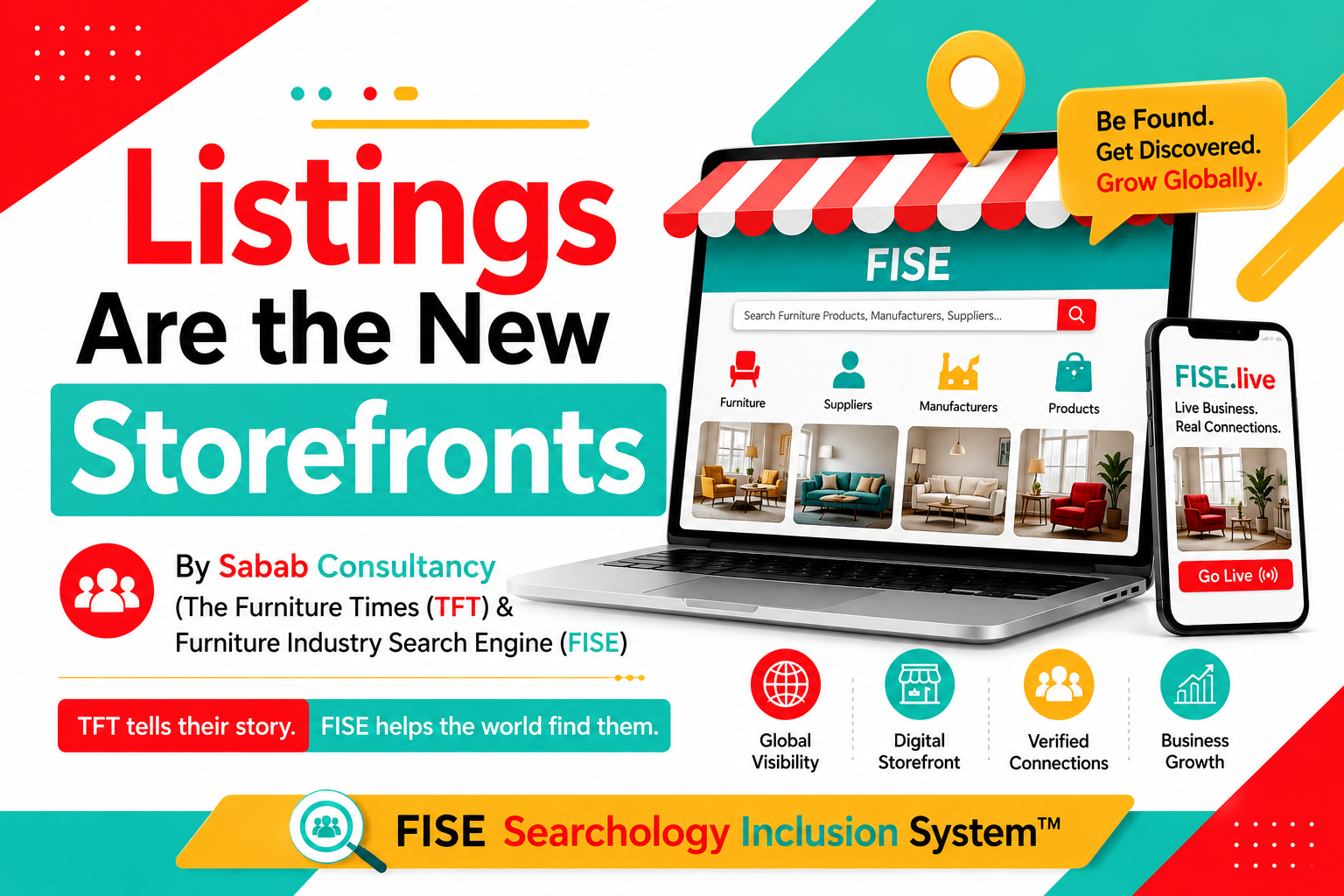
They are becoming digital storefronts.
They are becoming discovery points.
They are becoming business identities.
They are becoming pathways to customers, partners, investors, distributors, media, suppliers and global opportunities.
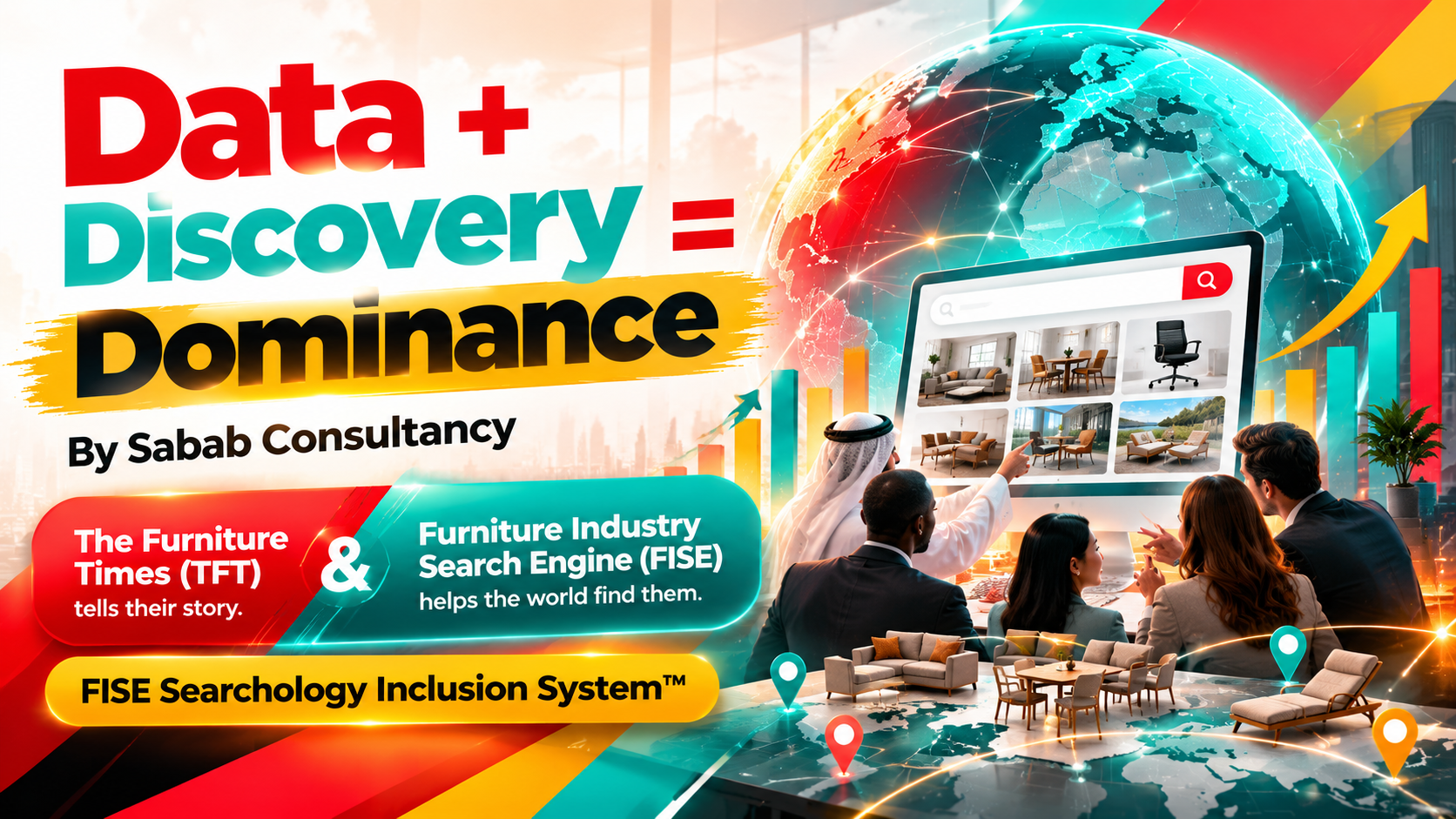
And this is where Sabab Consultancy, The Furniture Times (TFT), Furniture Industry Search Engine (FISE), FISE LIVE and the FISE Searchology Inclusion System™ enter a much bigger conversation about the future of business visibility.
TFT tells the story.
FISE helps the world find it.
FISE LIVE keeps visibility active.
And the FISE Searchology Inclusion System™ is designed around a much larger ambition:
To make digital discoverability more accessible to SMEs, artisans, makers and grassroots creators.
Because the future of commerce may not belong only to the businesses with the biggest stores.
It may belong to the businesses the world can find.
Think about the traditional storefront.
A business owner spends money on location, architecture, signage, lighting, displays and branding because they understand one fundamental principle:
If people cannot see you, they cannot walk in.
The internet has not eliminated this principle.
It has multiplied it.
Your digital presence is now your storefront.
Your business listing is your digital signboard.
Your profile is your digital showroom.
Your product information is your digital display window.
Your photographs are your visual merchandising.
Your story is your brand experience.
Your reviews, credentials, categories and business information become trust signals.
And search becomes the road that brings people to your door.
This changes everything.
A business that once competed for foot traffic now competes for digital discovery.
A manufacturer that once depended primarily on trade exhibitions can now be discovered by buyers searching from another country.
An artisan who once sold primarily within a local community can potentially become visible to people searching for exactly their craft.
A small furniture workshop that may never afford a massive advertising campaign can begin building a structured digital identity around what it actually does.
This is the opportunity.
But there is also a warning.
If your digital storefront is empty, outdated, poorly structured or practically invisible, your competitors may be occupying the space where your customers should have found you.
For years, small businesses were told that their biggest disadvantage was size.
Large companies had bigger budgets.
More employees.
More advertising.
More distribution.
More physical locations.
More resources.
But the digital economy introduced a new battleground.
Discoverability.
A small manufacturer can have extraordinary craftsmanship but weak digital visibility.
A family-owned furniture company can have decades of experience but almost no searchable information.
An artisan can create products with cultural significance but remain invisible outside their local market.
A grassroots creator can have enormous talent but no structured digital identity.
This creates an uncomfortable gap:
Value exists, but discovery does not.
That gap can destroy opportunity.
The customer is searching.
The buyer is searching.
The architect is searching.
The hotel procurement manager is searching.
The interior designer is searching.
The distributor is searching.
The investor is searching.
The journalist is searching.
The AI-powered discovery system is searching.
And the critical question becomes:
What happens when they search for what you offer?
Do they find you?
Or do they find someone else?
That question deserves serious attention.
Because the next competitive advantage may not simply be who produces the best product.
It may be who is easiest to discover, understand, trust and contact.
This is where the relationship between The Furniture Times and the Furniture Industry Search Engine becomes strategically important.
The Furniture Times is positioned around storytelling, industry intelligence, news, analysis, people, businesses, trends and narratives.
That matters because businesses need more than a name and telephone number.
They need context.
They need identity.
They need credibility.
They need a story that tells the market why they matter.
A manufacturer is not simply a manufacturer.
Behind that business may be generations of craftsmanship.
A founder may have spent decades building a reputation.
A workshop may employ families.
An artisan may preserve traditional techniques.
A small business may represent an entire local economy.
A creator may be carrying cultural knowledge into the next generation.
A listing captures existence. A story communicates significance.
That distinction is powerful.
TFT can tell the story.
FISE can create a structured pathway for discovery.
Together, the concept becomes larger than content.
It becomes:
Story + Search = Opportunity.
The story gives the business meaning.
Search gives the business discoverability.
And discoverability creates the possibility of action.
The old idea of a business listing was simple.
Name.
Address.
Phone number.
Website.
Maybe a few photographs.
That model is becoming outdated.
The modern business listing can become a digital identity layer.
It can communicate:
Who you are.
What you make.
What you sell.
Where you operate.
Which industries you serve.
Which categories you belong to.
What makes you different.
What markets you serve.
What capabilities you possess.
What your story is.
How people can contact you.
Where people can discover more about you.
The difference is enormous.
A static directory says:
“This business exists.”
A strategic visibility ecosystem can say:
“This business exists, this is what it does, this is why it matters, this is where it fits, and this is how you can engage with it.”
That is a completely different proposition.
The most important question in digital commerce is not merely:
Who has the best product?
It is:
Who gets discovered when demand appears?
The digital economy has created millions of businesses.
Millions of makers.
Millions of artisans.
Millions of manufacturers.
Millions of independent creators.
Millions of SMEs.
Yet discoverability remains uneven.
Some companies have sophisticated digital infrastructures.
Others have almost none.
Some businesses dominate search results.
Others struggle to appear even when someone is specifically looking for their products.
That is not simply a marketing problem.
It can become an economic problem.
Because visibility affects opportunity.
If buyers cannot discover suppliers, transactions are missed.
If consumers cannot discover makers, sales are missed.
If investors cannot discover promising businesses, partnerships are missed.
If media cannot discover interesting stories, exposure is missed.
If distributors cannot discover manufacturers, markets are missed.
If businesses cannot discover one another, collaboration is missed.
Invisible businesses do not stop creating value. They simply lose opportunities to convert that value into growth.
That is the gap a search-driven ecosystem attempts to address.
A listing that never changes can eventually become a digital business card sitting quietly on the internet.
But business does not stand still.
Products change.
Collections launch.
Companies win awards.
New partnerships happen.
Businesses expand.
Manufacturers introduce capabilities.
Artisans create new work.
Markets change.
Events happen.
Announcements matter.
This is why FISE LIVE represents an important shift in the visibility conversation.
The principle is simple:
Visibility should not be passive.
Businesses should have opportunities to remain active, relevant and discoverable.
FISE LIVE can be understood as a real-time visibility layer where businesses can communicate updates, activities, launches, products, announcements and developments.
The broader shift is from:
Static listings to active discovery.
From:
“Find me once.”
To:
“Stay connected with what I am doing.”
From:
A digital address.
To:
A digital presence.
This matters because attention is increasingly dynamic.
Markets move.
Buyer behavior changes.
Search behavior changes.
Trends emerge.
Opportunities appear.
Businesses that continuously communicate their relevance have more opportunities to remain part of the conversation.
The phrase Searchology represents a powerful idea:
Understanding how people search, how businesses become discoverable, and how digital ecosystems can connect demand with relevant supply.
The FISE Searchology Inclusion System™ takes that idea beyond conventional business listings.
It is presented as a global visibility engine for:
SMEs, artisans, makers and grassroots creators.
And its ambition goes beyond marketing.
It is:
A livelihood system.
A human impact system.
A search revolution.
A digital identity movement.
A global opportunity engine.
That distinction matters.
Because if visibility is treated only as advertising, businesses with larger budgets will always have an advantage.
But if visibility is treated as infrastructure, the conversation changes.
The objective becomes creating structured pathways that help businesses become discoverable according to their identity, category, capabilities and relevance.
That is a much bigger vision.
Behind every business listing is a human story.
Consider a small furniture workshop.
Maybe the founder started with one machine.
Maybe the business began in a garage.
Maybe the skills were passed from father to son.
Maybe the business employs ten local workers.
Maybe those workers support ten families.
Maybe the workshop uses traditional woodworking techniques.
Maybe its products have never reached an international market.
Now imagine that workshop becoming discoverable to an architect searching for handcrafted furniture.
That single discovery could become an inquiry.
The inquiry could become an order.
The order could become employment.
Employment could support families.
Growth could create training.
Training could preserve craftsmanship.
Craftsmanship could survive another generation.
This is why digital visibility should not always be discussed as a vanity metric.
It can have real-world consequences.
A search result can become a conversation.
A conversation can become an order.
An order can become income.
Income can become livelihood.
That is where the human impact of discoverability becomes impossible to ignore.
The global furniture industry is enormous, diverse and deeply fragmented.
It includes:
Manufacturers.
Exporters.
Importers.
Retailers.
Interior brands.
Architects.
Designers.
Artisans.
Woodworkers.
Upholstery specialists.
Component manufacturers.
Hardware suppliers.
Outdoor furniture makers.
Hospitality furniture suppliers.
Contract furniture companies.
Custom furniture studios.
Traditional craftspeople.
Small workshops.
Large factories.
Yet the digital representation of this enormous ecosystem can remain fragmented.
The industry can produce incredible products while still struggling with:
Poor categorization.
Weak online visibility.
Inconsistent business information.
Limited digital identity.
Insufficient product discovery.
Weak AI discoverability.
Dependence on intermediaries.
Overreliance on exhibitions.
Limited international exposure.
This creates a major opportunity.
The industry does not simply need more furniture. It needs better furniture discovery.
And that is precisely where a dedicated furniture industry search ecosystem becomes strategically interesting.
A generic directory asks:
“What businesses should we put into this database?”
A search-first ecosystem asks:
“How should the world discover these businesses?”
That difference is fundamental.
The furniture industry has specialized categories, terminology, supply chains, product types and buyer intentions.
Someone searching for:
“outdoor wicker furniture manufacturer”
has a different intention from someone searching for:
“hotel furniture supplier”
or:
“custom wooden furniture manufacturer”
or:
“restaurant furniture exporter”
or:
“handcrafted furniture artisan”
or:
“commercial furniture supplier”
or:
“rattan furniture manufacturer in Southeast Asia.”
The better the digital structure understands these differences, the more meaningful discovery can become.
Category matters. Context matters. Intent matters. Identity matters.
That is the foundation of search-driven business visibility.
There is another reason businesses should pay attention now.
Search is changing.
People are increasingly asking questions instead of typing simple keywords.
They want answers.
They want recommendations.
They want comparisons.
They want suppliers.
They want manufacturers.
They want specific products.
They want businesses that meet particular requirements.
AI-powered discovery makes structured digital information increasingly important.
A business cannot simply say:
“We make furniture.”
It needs a digital identity that helps communicate:
What kind of furniture?
For whom?
Where?
At what scale?
With what materials?
For which industries?
With what capabilities?
What makes the company credible?
What makes it different?
Where can someone learn more?
How can they contact the company?
This is why structured discoverability matters.
The future of visibility is not only about being indexed. It is about being understood.
And businesses that fail to establish clear digital identities risk becoming harder for both people and intelligent systems to understand.
Search visibility should not be limited to one platform.
The broader goal is discoverability across the digital ecosystem.
A business should be able to build signals around:
Its brand.
Its products.
Its categories.
Its expertise.
Its location.
Its industry.
Its story.
Its capabilities.
Its achievements.
Its relationships.
Its market relevance.
This creates what can be called a digital identity footprint.
The stronger and more consistent that footprint becomes, the easier it becomes for the market to understand who the business is.
This is especially important for SMEs.
Large companies often have teams dedicated to branding, public relations, digital marketing, content, communications and technology.
Small businesses frequently do not.
That is why systems designed around inclusion matter.
Digital opportunity should not belong only to companies that can afford massive visibility budgets.
Sabab Consultancy can be positioned within this wider conversation around business growth, digital transformation, visibility and opportunity.
The central question is no longer simply:
“How do we market this business?”
The more important question is:
“How do we make this business discoverable, understandable and relevant in a world increasingly driven by search?”
That requires a different mindset.
It requires businesses to stop treating digital presence as an optional decoration.
A website alone is not automatically visibility.
A social media account is not automatically discoverability.
A directory listing is not automatically opportunity.
A beautiful logo is not automatically recognition.
A product photograph is not automatically demand.
The real challenge is connecting these pieces into a coherent digital identity.
That is where strategic visibility becomes important.
Imagine a buyer looking for a furniture supplier.
They may not know your company.
They may not know your founder.
They may not know your factory.
They may not know your story.
They begin with a search.
That search produces possibilities.
They compare.
They investigate.
They look at products.
They assess credibility.
They search again.
They ask questions.
They shortlist.
Then they contact someone.
Notice what happened.
The customer journey began before the customer knew your name.
This is one of the biggest changes in modern commerce.
Businesses no longer compete only at the point of sale.
They compete at the point of discovery.
That means visibility has moved upstream.
It now influences the journey before the first conversation.
This is perhaps the most uncomfortable thought for business owners.
Your competitor does not always need to have a better product.
They may only need to be easier to find.
Imagine two furniture manufacturers.
Company A has outstanding craftsmanship but weak digital visibility.
Company B has good craftsmanship and a strong digital presence.
A buyer searches.
Company B appears.
The buyer investigates Company B.
The buyer sends an inquiry.
Company B wins the opportunity.
Company A never even enters the conversation.
The invisible business did not lose because it was inferior.
It lost because it was absent from the buyer’s discovery journey.
That is why businesses need to take digital visibility seriously.
A powerful listing should not be treated as the final achievement.
It should be treated as the foundation.
From there, a business can build:
A stronger digital identity.
More relevant content.
Better category positioning.
More business stories.
More product discovery.
More industry visibility.
More opportunities to communicate.
More opportunities to connect.
More opportunities to be remembered.
This creates a compounding effect.
Visibility creates discovery.
Discovery creates familiarity.
Familiarity can create trust.
Trust can create inquiries.
Inquiries can create relationships.
Relationships can create business.
And business can create livelihoods.
That is why a listing can be far more important than it looks.
Forget vanity metrics for a moment.
Forget how many followers you have.
Forget how many likes your last post received.
Ask something much more important:
If someone searches for exactly what my business provides today, can they discover me?
Then ask:
Can they understand what I do?
Can they understand who I serve?
Can they understand what makes me different?
Can they verify my identity?
Can they discover my products or capabilities?
Can they find my story?
Can they contact me?
If the answer to several of these questions is no, your digital storefront needs attention.
And waiting is not a neutral decision.
Every day you remain difficult to discover, someone else has an opportunity to become the answer to your customer’s search.
Artisans have something the digital economy desperately needs:
Authenticity.
Mass production can create scale.
But craftsmanship creates identity.
Handmade furniture.
Traditional woodworking.
Heritage crafts.
Natural materials.
Local techniques.
Cultural design.
Generational knowledge.
These are not merely products.
They are stories.
But stories cannot create economic opportunity if nobody discovers them.
That is why searchable digital identity can become a bridge between local craftsmanship and global demand.
An artisan should not need to become a technology expert simply to have a chance of being discovered.
A maker should not need a massive advertising budget to communicate what they create.
A grassroots creator should not disappear simply because they lack sophisticated digital infrastructure.
Inclusion means creating pathways for value to become visible.
This is where the FISE Searchology Inclusion System™ becomes much more than a technology conversation.
A digital identity can create a pathway.
A pathway can create discovery.
Discovery can create contact.
Contact can create commerce.
Commerce can create income.
Income can create livelihoods.
And livelihoods can strengthen communities.
This is why the language of a livelihood system is so significant.
The objective is not merely to create another online database.
The larger vision is to build an ecosystem where digital discoverability can support economic participation.
That is a fundamentally human objective.
Every major digital shift creates two groups.
Those who adapt early.
And those who wait until adaptation becomes unavoidable.
The same pattern is happening with search-driven visibility.
Businesses that establish strong digital identities now have more time to build recognition.
Businesses that structure their information now have more opportunities to become discoverable.
Businesses that tell their stories now have more opportunities to build authority.
Businesses that participate in industry ecosystems now can position themselves before competition becomes even more intense.
Waiting may feel safe.
But in a fast-changing digital economy, inaction can be one of the most expensive decisions a business makes.
A storefront used to be:
A building.
A sign.
A window.
A door.
Now it can be:
A search result.
A business listing.
A digital profile.
A product page.
An industry story.
A searchable category.
A digital identity.
A real-time update.
A discovery pathway.
The physical storefront still matters.
But it is no longer the only storefront that matters.
Your digital storefront may be open 24 hours a day to the entire world.
The question is whether anyone can find it.
Do not wait for the digital economy to force you to change.
Start now.
Audit your digital identity.
Search your own business name.
Search your products.
Search your industry category.
Search the phrases your customers would use.
Look at what appears.
Then ask what is missing.
Build a complete business identity.
Use accurate categories.
Present your products clearly.
Tell your story.
Show your capabilities.
Publish meaningful updates.
Create useful content.
Strengthen your industry presence.
Make your business easier to understand.
Make your business easier to discover.
And most importantly:
Stop thinking of visibility as a one-time marketing campaign.
Think of it as business infrastructure.
The marketplace is changing.
The showroom is changing.
The buyer journey is changing.
The search experience is changing.
The role of digital identity is changing.
And the businesses that understand this transformation early can position themselves for the next generation of opportunity.
TFT can tell the story.
FISE can help the world discover the business.
FISE LIVE can help keep that presence active.
The FISE Searchology Inclusion System™ can frame discoverability as something larger than advertising: a pathway toward digital identity, economic participation and global opportunity.
This is why the phrase matters:
Listings are the new storefronts.
Because a storefront tells the world:
“We are here.”
A modern digital storefront needs to communicate something more powerful:
“We are here. This is what we do. This is why we matter. This is what we create. This is who we serve. And this is how you can find us.”
That is the future of business discovery.
The next time someone searches for your product, your service, your category or your expertise, what happens?
Will your business appear?
Will your story appear?
Will your capabilities appear?
Will your products appear?
Will your digital identity make sense?
Will the buyer understand your value?
Will an opportunity find its way to you?
Or will your competitor occupy that space?
This is not simply a question about rankings.
It is a question about opportunity.
It is a question about livelihoods.
It is a question about whether small businesses, artisans, makers and grassroots creators will have a meaningful place in the digital economy.
The internet has already changed where people shop.
Search is changing how people discover.
AI is changing how people ask.
And digital identity is changing how businesses are understood.
The transformation has already started.
The businesses that prepare now will have an advantage over the businesses that wait.
If your business has value, make that value discoverable.
If your craftsmanship has a story, tell it.
If your products deserve global buyers, make them easier to find.
If your company creates jobs, build a digital identity that reflects its impact.
If you are an artisan, do not allow your work to remain hidden simply because your digital presence is weak.
If you are an SME, do not assume that being small means being invisible.
If you are a manufacturer, do not wait for buyers to magically discover you.
Build the pathway.
The future of commerce will increasingly belong to businesses that understand one simple truth:
You cannot be chosen if you cannot be found.
And this is why the work around Sabab Consultancy, The Furniture Times, FISE, FISE LIVE and the FISE Searchology Inclusion System™ represents a much larger idea than business listings.
It represents a shift from:
Location to discoverability.
Directories to digital identity.
Static listings to active visibility.
Advertising to structured discovery.
Attention to opportunity.
Business presence to economic participation.
The storefront has moved.
The marketplace has changed.
The customer journey has evolved.
Now businesses must evolve with it.
Tell your story. Build your digital identity. Strengthen your discoverability. Get found before your competitor does.
Because tomorrow’s biggest businesses may not necessarily be the ones with the biggest storefronts.
They may be the ones the world can find.
Do not wait until your customers are already searching for your competitor.
Start building your discoverability today.
Explore how your business can strengthen its digital identity, industry presence and search visibility through the wider ecosystem of Sabab Consultancy, The Furniture Times and FISE.
If you are an SME, manufacturer, furniture brand, artisan, maker or grassroots creator, ask yourself one question before the next opportunity passes:
“If the world is searching for what I create today, can the world find me?”
If the answer is not a confident yes, your visibility strategy needs to start now.
Your product deserves discovery.
Your story deserves attention.
Your business deserves opportunity.
The world is searching. Make sure it finds you.
We wholeheartedly support all 17 UN Sustainable Development Goals through our collaborative efforts at SaBab Consultancy and beyond.

We wholeheartedly support all 17 UN Sustainable Development Goals through our collaborative efforts at SaBab Consultancy and beyond.

We wholeheartedly support all 17 UN Sustainable Development Goals through our collaborative efforts at SaBab Consultancy and beyond.










Copyright © 2023 Sabab Consultancy Designed by SIB Infotech