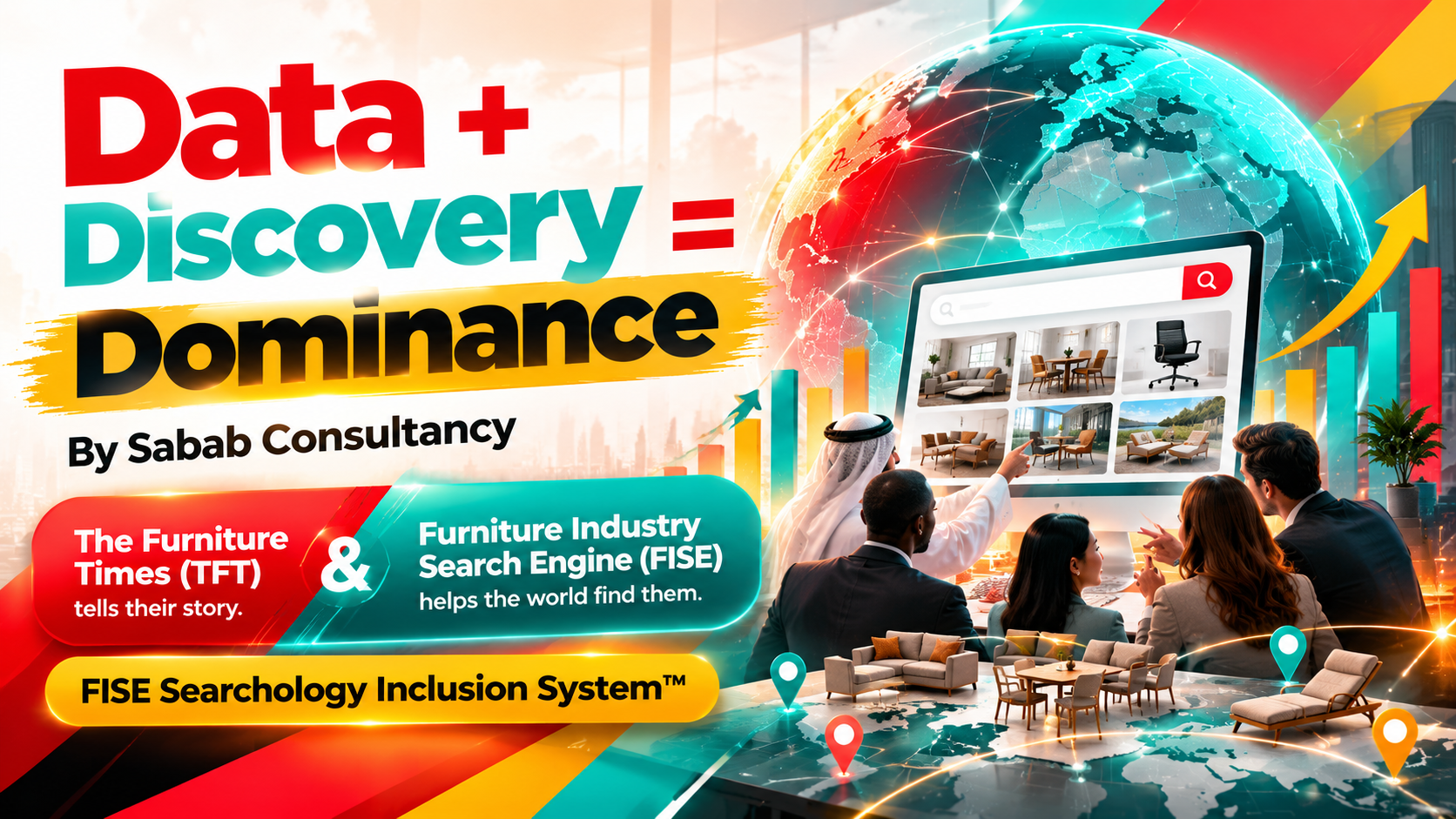
By Sabab Consultancy | The Furniture Times (TFT) and Furniture Industry Search Engine (FISE)
In today’s digital economy, being talented is not enough. Building a quality product is not enough. Running an honest business, serving customers faithfully, and creating something valuable with your hands are not enough if the world cannot find you. Across the furniture industry and countless small-business communities, talented people are working tirelessly to build their livelihoods, yet many remain invisible in the very digital spaces where customers, buyers, partners, and opportunities are being discovered.
This is the challenge that Data + Discovery = Dominance seeks to address. It is a powerful business principle at the heart of Sabab Consultancy’s vision for The Furniture Times (TFT), the Furniture Industry Search Engine (FISE), and the emerging FISE Searchology Inclusion System™. The objective is not simply to place more businesses online. It is to help meaningful businesses become discoverable, strengthen their digital identities, and create pathways toward broader recognition and opportunity.
The question is no longer whether your business exists. The real question is whether the right people can find it when they need what you offer.
Every day, furniture manufacturers, independent artisans, carpenters, workshops, small retailers, material suppliers, home-based entrepreneurs, and grassroots creators contribute to local economies. They develop products, preserve craftsmanship, create employment, and support families. Some have decades of experience. Others are emerging entrepreneurs with extraordinary potential.
Yet many face the same obstacle: limited digital visibility.
A furniture maker may produce exceptional handcrafted tables but struggle to reach buyers beyond the local market. A small workshop may offer reliable manufacturing services but remain unknown to procurement teams. An independent designer may have innovative ideas but lack the resources to compete with larger brands for online attention. A family-owned business may possess an outstanding reputation in its community without having a digital identity that communicates its value to the wider world.
This is not necessarily a problem of quality. It is often a problem of discoverability.
The internet has created unprecedented access to information, but access alone does not guarantee inclusion. A business can have a product, a story, a name, and a genuine customer promise while still being difficult to discover through search engines and digital platforms.
When visibility is limited, opportunities can be limited too. Potential customers may never learn that a business exists. Buyers may overlook capable suppliers. Emerging creators may struggle to build credibility beyond their immediate networks.
A business that cannot be discovered has a visibility problem, and a visibility problem can become a growth problem.
The solution begins with a more deliberate approach to digital identity, structured business information, relevant discovery, and sustained visibility.
Data is the foundation of digital identity. Discovery is the process of connecting that identity with people looking for relevant products, services, expertise, and opportunities. When these elements work together, businesses have a stronger foundation for building recognition and reaching new audiences.
This is the thinking behind the formula:
Data + Discovery = Dominance
Data provides the information that helps the digital world understand a business. Discovery helps that information reach relevant audiences. Together, they can support stronger market positioning, improved discoverability, and more informed commercial connections.
Consider a small furniture manufacturer. Its business name, location, product categories, manufacturing capabilities, materials, service areas, contact details, and brand story all contribute to its digital identity. When this information is accurate, consistent, organized, and accessible, potential buyers have more ways to understand what the manufacturer offers.
Now consider what happens when that information is supported by relevant industry content, searchable business profiles, useful product descriptions, and a platform designed around the furniture sector. The manufacturer has a clearer opportunity to appear in relevant discovery journeys.
This does not guarantee first-page rankings, instant sales, or global dominance. Search performance depends on many factors, including competition, relevance, website quality, technical accessibility, reputation, and the needs of the searcher. However, building a strong digital foundation makes it easier for potential customers to understand and evaluate a business.
For small businesses, that foundation matters.
Dominance, in this context, should not be understood as overpowering competitors. It means building a stronger position in the markets that matter to your business, becoming easier to recognize, and increasing your chances of being considered when relevant opportunities emerge.
Behind every business is a story.
There is the founder who invested personal savings to open a workshop. There is the artisan who learned a traditional craft from an older generation. There is the manufacturer who employs local workers and delivers products despite rising costs. There is the independent designer who continues creating after facing repeated rejection. There is the small business owner who dreams of taking a local product into international markets.
These stories deserve more than a passing mention.
The Furniture Times (TFT) approaches the furniture ecosystem through the power of industry storytelling, information, and visibility. Its central message is simple: TFT tells their story.
A business story can help audiences understand the people, expertise, values, and experiences behind a product. Industry-focused editorial content can provide context that a basic listing may not capture. It can help explain what a company does, how it works, what makes its approach distinctive, and why its contribution matters.
For emerging businesses, telling that story can be an important part of establishing a recognizable digital presence.
However, effective storytelling must be grounded in accurate information. Strong content should communicate real capabilities, genuine achievements, and verifiable details rather than relying on exaggerated claims. Trust grows when a business communicates clearly and consistently.
TFT’s role within this broader vision is to help the furniture industry communicate its stories, showcase its participants, and make valuable information more accessible to the people who need it.
Because a product may attract attention, but a compelling and credible story can help people remember the business behind it.
If TFT tells the story, FISE helps the world find them.
The Furniture Industry Search Engine (FISE) is positioned around a fundamental challenge facing the furniture ecosystem: connecting relevant business information with people actively searching for it.
The furniture industry is broad and interconnected. It includes manufacturers, retailers, wholesalers, interior designers, furniture makers, raw-material suppliers, component producers, artisans, exporters, importers, service providers, and independent creators. Each group contributes to the industry, but discovering the right business can be difficult when information is scattered across different platforms and formats.
A general search may return thousands of results, many of which are not relevant to a particular requirement. A buyer looking for a specialist manufacturer needs different information from a homeowner searching for a furniture retailer. An interior designer seeking a custom workshop has different priorities from a distributor looking for a production partner.
Industry-focused discovery can help make these searches more relevant by organizing information around the needs of a specific sector.
FISE’s vision is to make the furniture ecosystem easier to navigate by helping businesses establish searchable digital identities and giving audiences a more focused way to discover industry participants.
Imagine a buyer looking for a furniture manufacturer with specific capabilities. A well-organized digital profile could communicate the company’s location, products, materials, production capabilities, service areas, and contact information. Instead of relying entirely on chance encounters or disconnected recommendations, the buyer would have a clearer starting point for evaluating potential suppliers.
For a small manufacturer, that is an opportunity to be considered.
For a buyer, it is an opportunity to discover a relevant supplier.
For the industry, it is a step toward making its business landscape more visible and accessible.
This is the principle behind FISE: helping relevant businesses become easier to find and helping people discover businesses they might otherwise overlook.
The next part of this vision is the FISE Searchology Inclusion System™, described as a global visibility engine for SMEs, artisans, makers, and grassroots creators.
The name reflects a broader approach to discovery: bringing together structured information, search visibility, digital identity, and inclusion-oriented thinking to help businesses participate more effectively in the digital economy.
Many small enterprises do not have dedicated marketing departments. They may lack the budget for complex websites, extensive advertising campaigns, professional content production, or specialist search optimization. Independent artisans and grassroots creators may possess extraordinary skills but have limited access to the digital infrastructure that larger organizations take for granted.
If digital opportunity depends only on who can spend the most, countless capable people risk remaining overlooked.
An inclusion-oriented visibility system starts from a different premise: businesses should have practical pathways to establish their identities, communicate their offerings, and become discoverable by relevant audiences.
The FISE Searchology Inclusion System™ is intended to bring this principle into the furniture industry’s digital discovery landscape.
Its broader vision can be understood through five connected dimensions.
First, it is a livelihood system in the sense that improved discoverability can help businesses pursue customers, strengthen commercial relationships, and support the people whose income depends on their work.
Second, it is a human impact system because businesses are not merely names in a database. They represent workers, families, founders, skills, ambitions, and communities.
Third, it is a search revolution in its ambition to make industry information more organized, relevant, and accessible to those looking for it.
Fourth, it is a digital identity movement because businesses need more than a social media account or a temporary advertisement. They need clear, consistent information that communicates who they are and what they offer.
Fifth, it is a global opportunity engine in its aspiration to connect local capabilities with broader discovery opportunities across markets.
These are ambitious objectives, and their real value will depend on execution, accessibility, information quality, user experience, and measurable outcomes. The principle, however, is worth taking seriously: digital visibility should help more capable businesses participate in the marketplace, not simply reward the organizations that already dominate attention.
Advertising can introduce a business to new audiences, but what happens after someone sees the advertisement?
A potential customer may search for the business name. A buyer may investigate its capabilities. A supplier may check its location and contact information. A prospective partner may want to understand its experience and products.
If the information is incomplete, inconsistent, outdated, or difficult to find, an initial moment of interest may not translate into a meaningful conversation.
This is why digital identity deserves attention before businesses continually increase their advertising expenditure.
A useful digital identity should communicate the essentials. Who are you? What do you sell or manufacture? Who do you serve? Where do you operate? What makes your capabilities relevant? How can someone contact you? What information helps a prospective customer assess whether you are the right fit?
For a furniture manufacturer, this might include product categories, manufacturing specializations, material options, minimum order requirements, customization capabilities, delivery regions, certifications where applicable, and professional contact details.
For an artisan, it could include craftsmanship, signature products, production methods, commission options, and the story behind the work.
For a small furniture retailer, it might include its location, collections, customer segments, delivery options, and after-sales services.
The objective is not to publish everything about a business. It is to make the right information available in a clear and trustworthy format.
When this information is organized properly, businesses create a stronger foundation for search visibility, customer confidence, and meaningful discovery.
One of the most important possibilities offered by digital discovery is the ability to extend the reach of local expertise.
A workshop serving a single town may have the capabilities to supply customers in other regions. An independent artisan may create products that appeal to international buyers. A small manufacturer may be ready to explore export opportunities but lack access to the networks through which prospective buyers discover suppliers.
Geography still matters. Logistics, regulations, production capacity, pricing, product standards, and buyer requirements influence whether an opportunity becomes a successful commercial relationship. Digital visibility cannot remove these realities.
But it can help more people learn that an opportunity exists.
When business information becomes easier to discover, local enterprises may have more opportunities to introduce themselves to new markets, establish contacts, and communicate their capabilities beyond their immediate surroundings.
For the furniture industry, this is especially relevant because commercial relationships often involve multiple participants. A manufacturer may need a component supplier. A retailer may need a new production partner. An interior designer may need a specialist workshop. An exporter may be searching for a reliable source of products.
Every successful connection begins with discovery.
FISE’s broader ambition is to support this process by bringing the industry’s business identities into a more focused discovery environment. The FISE Searchology Inclusion System™ extends that ambition toward SMEs, artisans, makers, and grassroots creators who may otherwise have fewer resources to establish their digital presence.
The opportunity is not to promise every business an international customer. It is to make valuable capabilities easier to find and evaluate.
Visibility becomes more meaningful when people can act on what they discover.
FISE LIVE can be understood as part of the broader vision of bringing business discovery closer to real participation and engagement. A searchable business profile may help someone find a company, but the next question is what happens after that discovery.
Can a buyer learn more about the company? Can a potential partner understand its capabilities? Can a business communicate its offering clearly? Can interested audiences move toward a useful conversation?
The distance between discovery and action is where many commercial opportunities are either developed or lost.
For businesses, this means that a digital presence should not stop at publishing a name and expecting results. Profiles and supporting content should help visitors understand the offering and identify a clear next step.
Depending on the features available on a particular platform, that next step might involve viewing product information, contacting a business, requesting a quotation, exploring an editorial feature, or learning more about its capabilities.
FISE LIVE belongs within this larger conversation about creating a more connected discovery experience. Its practical impact should be assessed through the functions it provides, the participation it enables, and the outcomes it helps users pursue.
The underlying principle remains clear: visibility creates an opening, but useful engagement is what can move an opportunity forward.
The way people discover businesses continues to evolve.
Customers may use traditional search engines, online marketplaces, social platforms, specialist directories, digital publications, and AI-powered assistants to research products and identify potential suppliers. Different people may use different language to describe the same need.
One buyer might search for a custom furniture manufacturer. Another might look for a solid-wood furniture supplier. A third might ask an AI assistant to help identify companies that produce furniture for hotels or commercial interiors.
Businesses that communicate their capabilities clearly across relevant digital touchpoints give search systems and human audiences better information to work with.
This does not mean that publishing more pages automatically produces better rankings or that every business will be recommended by AI systems. Search and recommendation systems use different signals, and their results cannot be guaranteed.
It does mean that accurate business details, descriptive content, consistent terminology, accessible pages, useful answers, and credible supporting information are sensible foundations for discoverability.
A furniture business should not describe itself only as a company that sells furniture if it has more specific capabilities worth communicating. If it specializes in hospitality furniture, outdoor furniture, bespoke manufacturing, commercial projects, or handcrafted wooden products, those details can help relevant audiences understand its offering.
The same principle applies to artisans and independent creators. Clear descriptions of their products, techniques, locations, and services can make their work easier to understand and discover.
FISE’s industry-focused approach can contribute to this larger objective by emphasizing the organization and discovery of relevant furniture-sector information.
The future belongs not simply to businesses that publish the most content, but to those that make their value easier to understand, verify, and find.
Digital transformation is often discussed through the language of technology, automation, analytics, and efficiency. These are important considerations, but they do not tell the whole story.
There is also a human question: who benefits from digital transformation, and who remains excluded?
Large companies may have teams responsible for marketing, search optimization, public relations, product photography, customer acquisition, and digital infrastructure. Smaller businesses frequently have to manage these responsibilities while also producing goods, serving customers, managing cash flow, and keeping daily operations running.
Artisans and grassroots creators can face an additional challenge. Their work may depend on specialized skills that are difficult to communicate through conventional advertising. Their value may be immediately apparent to someone who sees the product in person but less obvious to someone encountering a brief online description.
An inclusion-oriented system should recognize these differences.
It should aim to make participation understandable, accessible, and relevant. It should encourage accurate information, help businesses communicate their capabilities, and create pathways through which potential customers can discover their work.
Inclusion also requires attention to practical barriers such as language, digital literacy, affordability, accessibility, and the ability to keep business information current.
The FISE Searchology Inclusion System™ places these questions at the center of its stated vision. Its significance will ultimately be demonstrated by how effectively it supports the businesses and creators it seeks to include.
The strongest measure of a digital inclusion initiative is not how many people hear its message. It is whether more people can use its opportunities meaningfully.
The principle of Data + Discovery = Dominance becomes useful when it leads to practical decisions.
Furniture businesses do not need to transform their entire marketing strategy overnight. They can begin by strengthening the information that prospective customers and partners need most.
Start by auditing your digital identity. Search for your business name and review the information available across your website, business profiles, directories, and social channels. Look for inconsistencies in your name, address, contact information, product descriptions, and service areas. Correct outdated details and make sure that your main business information is easy to understand.
Next, clarify your positioning. Do not assume that every visitor understands your products or capabilities. Describe the categories you serve, the customers you help, and the problems your business can solve. A clear description of a specialist capability is often more useful than a generic claim that you provide the best quality.
Then, improve the information behind your products. Include accurate descriptions, relevant specifications, materials, dimensions where applicable, customization options, and appropriate photographs. For B2B suppliers, provide enough detail to help prospective buyers assess whether a conversation is worthwhile.
Build a consistent content foundation. Share useful information about manufacturing capabilities, materials, craftsmanship, design applications, industry challenges, and the questions customers frequently ask. Ensure that each piece of content offers genuine value rather than repeating promotional claims.
Explore relevant industry-focused discovery opportunities. A specialist platform may help your business reach an audience whose needs are closer to your products and services than those of a broad, general audience. Assess platforms based on their relevance, functionality, transparency, audience, and ability to help users take meaningful next steps.
Finally, measure what happens. Track qualified inquiries, quotation requests, relevant website visits, customer conversations, and the quality of the connections you make. Visibility is important, but meaningful commercial outcomes provide a clearer picture of whether your strategy is working.
The purpose is not to chase every possible source of traffic. It is to become easier to discover by the people who have a genuine reason to find you.
A month of focused action can help a business establish a stronger starting point for digital discovery.
During the first week, review your existing digital identity. Check your business name, description, contact details, product categories, location, and online profiles. Identify missing or conflicting information and correct the most important issues.
During the second week, strengthen your business story and product information. Write a clear company description, prepare accurate product or service descriptions, collect suitable photographs, and explain what distinguishes your capabilities. Avoid unsupported superlatives and focus on details that help customers make decisions.
During the third week, expand relevant discovery opportunities. Review suitable industry directories, specialist platforms, business networks, and editorial opportunities. Consider whether FISE and its associated initiatives fit your business goals, audience, and visibility strategy. Evaluate the available features and terms before committing resources.
During the fourth week, review engagement and plan the next steps. Record inquiries, profile visits where available, referrals, quotation requests, and other relevant indicators. Identify which information attracts useful attention and which areas require improvement.
At the end of the month, ask three questions.
Can the right people understand what my business offers?
Can they discover my business through relevant searches and industry channels?
Can they take a clear next step when they find me?
If the answer to any of these questions is no, the next improvement becomes easier to identify.
This is how a broad digital vision becomes a practical business discipline.
Any initiative built around digital inclusion and business visibility should be judged by more than ambitious language. It should be evaluated through the usefulness of its services and the outcomes it helps participants pursue.
For SMEs, artisans, makers, and grassroots creators, meaningful indicators could include the completeness of business profiles, the accuracy of published information, relevant discovery activity, qualified inquiries, engagement from potential buyers, and connections that lead to genuine commercial conversations.
Other important measures include accessibility for businesses with limited digital resources, the ease of maintaining information, the relevance of search results, and the quality of the user experience.
For The Furniture Times, the value of storytelling can be evaluated through the relevance and accuracy of published features, the depth of industry information, and the opportunities created for businesses to communicate their work.
For FISE, useful indicators include whether people can find relevant businesses more easily and whether the information available helps them make informed decisions.
For FISE LIVE, the relevant questions concern participation, engagement, and the practical steps users can take after discovering a business.
These are proposed ways to assess impact, not claims that specific results have already been achieved. Transparent reporting and measurable evidence are essential to building trust.
A strong visibility initiative should make its value understandable to the people it serves.
The furniture industry is built on materials, machinery, craftsmanship, design, logistics, commercial relationships, and customer experience. Increasingly, it also depends on the ability to communicate these strengths through digital channels.
A capable manufacturer needs to be discoverable by potential buyers. An artisan needs a way to communicate the value of a specialized skill. A retailer needs to help customers understand its collections. A designer needs to reach people looking for relevant expertise. An emerging enterprise needs opportunities to establish credibility and develop commercial relationships.
These needs are connected.
The Furniture Times and the Furniture Industry Search Engine represent complementary parts of a broader vision: one focused on telling industry stories, the other on helping audiences discover the businesses behind those stories.
FISE LIVE and the FISE Searchology Inclusion System™ extend that vision toward participation, visibility, and a more inclusive digital ecosystem.
Sabab Consultancy’s Data + Discovery = Dominance principle brings the central message into focus. Business information should not remain disconnected from the people who could benefit from it. Stories should have a pathway to discovery. Capabilities should be communicated clearly. Small businesses should have practical ways to strengthen their digital identities.
Technology alone cannot guarantee success. Every business still needs a valuable offering, dependable service, sound operations, and relationships built on trust. But digital visibility can help create the conditions in which those strengths have a greater chance of being recognized.
Think about the furniture maker whose work deserves a wider audience. The small manufacturer capable of serving new buyers. The artisan preserving a valuable skill. The grassroots creator with an idea that could become a sustainable business.
Their challenge is not always a lack of talent, commitment, or ambition. Sometimes, the missing link is a clear path between what they offer and the people searching for it.
That is why the conversation around digital visibility matters.
The Furniture Times tells their story. FISE helps the world find them. FISE LIVE belongs to the broader vision of connecting discovery with participation. The FISE Searchology Inclusion System™ sets out an ambition to make digital visibility more accessible to SMEs, artisans, makers, and grassroots creators.
Together, these initiatives point toward an important possibility: a digital economy in which more businesses can communicate their value, more people can discover relevant capabilities, and more opportunities can begin with a simple search.
If you are a furniture manufacturer, artisan, designer, retailer, supplier, or emerging entrepreneur, begin by asking yourself a direct question: when someone searches for what I offer, can they find me, understand me, and contact me?
If the answer is uncertain, do not wait until your competitors have strengthened their digital presence further. Start improving your business information, clarify your story, build your discoverability, and explore relevant industry platforms that align with your goals.
Because the value you create matters. The people behind your business matter. And the opportunities you cannot be found for may be the opportunities you never get to pursue.
Data builds your digital identity. Discovery creates the possibility of connection. Consistent execution turns that possibility into progress.
Data + Discovery = Dominance.
Explore the vision. Strengthen your visibility. Help the world discover what your business has to offer.
By Sabab Consultancy, in connection with The Furniture Times (TFT), the Furniture Industry Search Engine (FISE), FISE LIVE, and the FISE Searchology Inclusion System™.
We wholeheartedly support all 17 UN Sustainable Development Goals through our collaborative efforts at SaBab Consultancy and beyond.

We wholeheartedly support all 17 UN Sustainable Development Goals through our collaborative efforts at SaBab Consultancy and beyond.

We wholeheartedly support all 17 UN Sustainable Development Goals through our collaborative efforts at SaBab Consultancy and beyond.










Copyright © 2023 Sabab Consultancy Designed by SIB Infotech