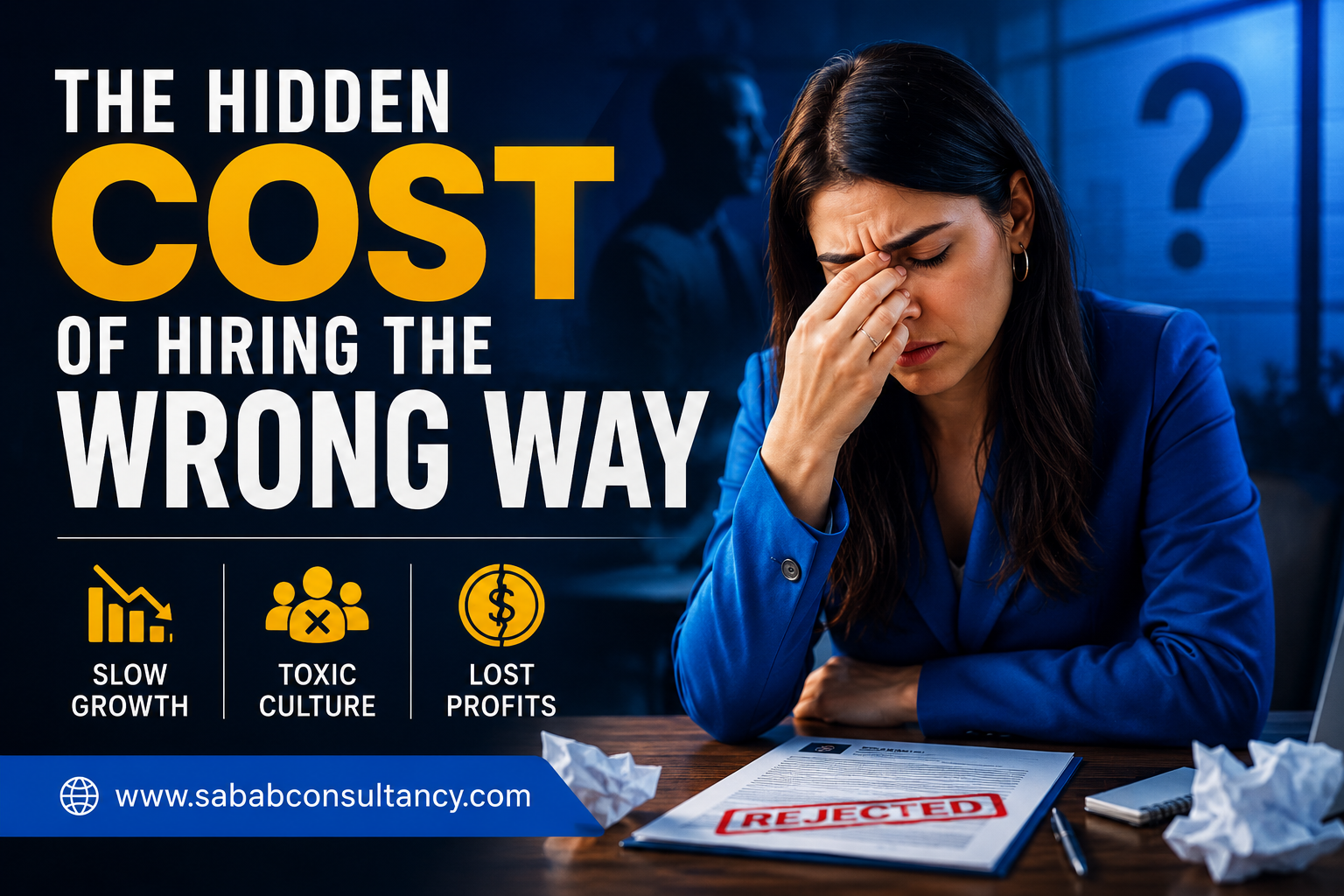
In today’s competitive world, hiring is no longer just an HR function. It is a strategic business decision that directly influences growth, brand reputation, customer satisfaction, and long-term survival. Yet, many businesses still treat recruitment as a rushed checkbox process instead of a high-impact investment.
The truth is simple but uncomfortable: one wrong hire does not just cost a salary. It can silently drain productivity, damage team morale, slow innovation, increase operational costs, and even push your best employees to leave.
This is the hidden cost of hiring the wrong way.
The Real Problem Behind Most Hiring Failures
Most hiring mistakes do not happen because talent is unavailable. They happen because the hiring process itself is broken.
Companies often focus too much on resumes instead of real capability. They prioritize speed over accuracy. They get influenced by impressive interviews rather than consistent performance indicators. And in many cases, hiring decisions are made under pressure instead of strategy.
The result is predictable: the wrong person enters the system, and the system slowly starts breaking from within.
The Silent Financial Drain You Don’t Notice Immediately
A bad hire rarely looks like a disaster on day one. In fact, they may even perform moderately well in the beginning. But over time, hidden costs start accumulating.
These costs include:
Lost productivity from missed deadlines and repeated work
Management time wasted on supervision and correction
Training costs that never convert into performance
Lower team output due to dependency imbalance
Increased recruitment costs for replacement
What looks like a small hiring mistake can easily turn into a long-term financial burden that affects profitability more than most leaders realize.
The Emotional Damage Inside Your Team
Numbers are only half the story. The emotional impact inside the team is often more destructive.
When a wrong hire consistently underperforms, top performers start feeling frustrated. They begin compensating for the lack of output. Over time, resentment builds. Motivation drops. Collaboration weakens.
In many cases, high-performing employees eventually leave—not because of the work itself, but because of the environment created by poor hiring decisions.
This is where businesses lose their strongest asset: trust inside the team.
The Strategic Cost: Slowing Down Business Growth
Every business has momentum. The right team accelerates it. The wrong hire slows it down.
A misaligned employee can delay projects, reduce innovation speed, and create dependency bottlenecks. Instead of scaling operations, leadership gets stuck fixing avoidable problems.
Even worse, leadership attention shifts away from growth opportunities toward damage control. This opportunity cost is one of the most underestimated impacts of poor hiring.
Why Traditional Hiring Methods Are Failing
Old hiring methods were built for a slower world. Today’s business environment demands adaptability, emotional intelligence, and execution capability—not just academic qualifications or job experience.
Yet many organizations still rely on:
Overloaded resumes
Generic interviews
Unstructured evaluation systems
Gut-based decisions
These outdated methods fail to predict real-world performance, leading to repeated hiring mistakes.
The Hidden Risk: Culture Erosion
Company culture is not built through vision statements. It is built through daily behavior inside the team.
One wrong hire can slowly introduce:
Lack of accountability
Poor communication habits
Negative mindset influence
Resistance to systems and structure
If not corrected early, this cultural erosion spreads quietly and becomes difficult to reverse.
The Urgency Most Businesses Ignore
The most dangerous part of hiring mistakes is not the mistake itself—it is delayed realization.
By the time leadership recognizes the problem, the cost has already multiplied. Projects have been delayed. Team morale has dropped. Customers may have experienced inconsistency. And valuable employees may have already started disengaging.
This is why hiring must be treated as a high-stakes decision, not an administrative task.
Building a Better Hiring Mindset
Improving hiring outcomes is not about hiring more people. It is about hiring more accurately.
Businesses that succeed long-term focus on:
Structured evaluation systems instead of assumptions
Skill-based assessments instead of surface-level interviews
Cultural alignment alongside technical capability
Trial performance indicators before full onboarding
Data-driven hiring decisions instead of emotional bias
When hiring becomes intentional, business stability improves dramatically.
Final Thought
The hidden cost of hiring the wrong way is not just financial. It is structural, emotional, and strategic. It affects how fast you grow, how strong your team becomes, and how sustainable your business will be in the long run.
Every hire is either building your future or silently slowing it down. The difference lies in the system you use to decide.
Ignore hiring quality, and you will keep paying for it in ways that are not immediately visible—but deeply damaging over time.